
Sermon for the Potter and the Clay – Isaiah 64:1-9
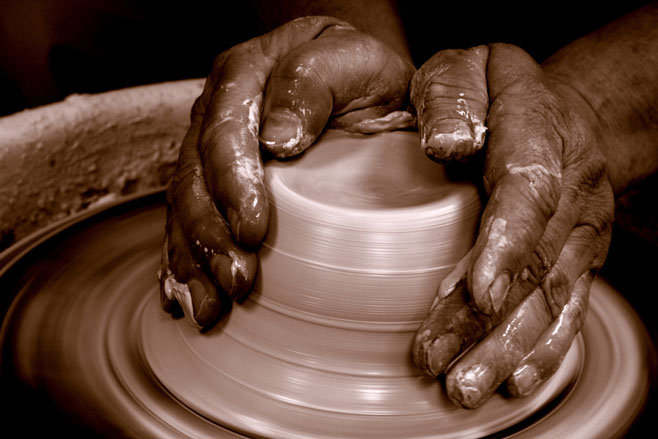
The prophet Isaiah prays, “Yet, O Lord, you are our Father; we are the clay, and you are our potter; we are all the work of your hand.” I remember elementary school, when we had art class a few days a week. Oh, the things we used to do with paper and fingerpaint and yarn, and whatever else the teacher could think of, bless her heart. God only knows how much paste we ate in that room. I always loved art, except for those days when we got the ball of clay. This palm-sized magenta ball of cold, hard clay, and it’s like you had to warm that stuff up forever with your hands before you could do anything with it, and maybe by the time the bell rang I had a snake and that was about it. Or at least that’s all I can remember.
We are the clay and you are our potter. It’s such an earthy image, God working at the potter’s wheel, slowly turning and shaping some unremarkable lump into creation. God’s skilled fingers furrowing crevices and curves, folding into the middle to push and pull and create space where there wasn’t any before. But that’s just the romantic part. You have to start at the very beginning, with a cold, hard lump that needs so much preparation to soften up. Moisture. Temperature. Time. Patience. Some kind of faith to know that this worthless hard lump of earth could be transformed into anything of value.
That’s really what Advent is about. Time. Patience. Faith to know that God really is doing something of earth-shaking proportions, even if nothing seems to be changing. And right now we’re desperate for change, because things are getting worse. Every day we hear more allegations of violation and harassment. More victims saying “me too”. But we don’t always believe them. We think they lie. Or we say “but you can’t be a victim, you’re so successful!” Or sometimes we believe them but we wonder if maybe they had a hand in it. Wrong place, wrong clothes, wrong words. We’re hell-bent on figuring out a reason. And even if we’ve been victimized ourselves, we still cling to some kind of fantasy that people aren’t capable of that kind of violence and damage. Our hearts can be hard as clay in our convictions. But we also think about the grace of Jesus. We constantly teach each other to interpret our neighbor’s actions in the best possible light. We remember how Jesus warns us over and over again about judging. Except, holding our tongues doesn’t seem to save anyone from danger. So, what’s the difference between God’s grace and our denial?
Continue reading gracewerks