Sermon for Time after Pentecost – Mark 6:14-29
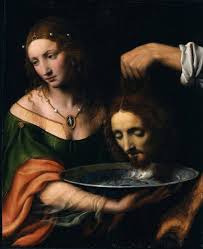
Immediately the king sent a soldier of the guard with orders to bring John’s head. He went and beheaded him in the prison, brought his head on a platter, and gave it to the girl. Then the girl gave it to her mother. The gospel of the Lord? I don’t know – that’s one messed up story. First off, it’s a story about Herod, so let’s remember who he is. This is Herod Antipas. His dad was Herod the Great. Dad’s ruthless, murderous, paranoid. Hears about the birth of Jesus, the king of the Jews, and orders the slaughter of all the male infants in the kingdom because he thinks Jesus is a threat. There’s more but you get the picture. This Herod is the son. When that’s your parental role model, you’re going to have a few issues. You’re probably used to getting whatever you want. So, this Herod goes off to Rome to visit his brother Philip, wife Herodias, and daughter Salome. He likes what he sees and steals Herodias away to be his wife. But he takes Salome too. Family values?
Now, here comes John the Baptist. We know he’s a prophet, which means he’s all about speaking truth to power, and he can’t keep his mouth shut. He tells Herod like it is – you stole your brother’s wife. You’re breaking God’s law. Yet, how odd that Herod LIKES John ANYWAY. When he heard him, he was greatly perplexed; and yet he liked to listen to him. Go figure. Herodias on the other hand, she wants John dead. John’s message REALLY gets under her skin, which tells you that apparently, she didn’t exactly MIND being stolen away by Herod. So imagine the bedroom fight. Herodias wants John dead, Herod wants John alive. Evidently you get Herodias off your back by putting John in prison. At least it keeps John around. John should be thankful, right? Aren’t three squares better than eating locusts in the desert? Maybe not. It’s prison.
Alright, so now it’s Herod’s birthday. He throws his OWN party. You know it’s going to be swank. Big banquet. Powerful and famous guests. Like politicians and CEOs and big celebrities. And a few church leaders. That’s not controversial at all! So out comes Salome who does a little dance for him and all the guests (you know they’ll all be powerful men), and they’re all so…. PLEASED… with her. Especially Herod. Whatever you ask me, I will give you, even half of my kingdom. That’s provocative. Think about how Herod stole Herodias in the first place, and it was a windfall for her. Half the kingdom means Herod kind of wants to give the daughter the same things he wanted to give the mother. You can read THAT a lot of ways. It’s creepy. Maybe the daughter is a trophy like the mother. Maybe this dance was provocative. Salome’s not a little girl. But she’s young and naive. Herod makes the offer and Salome immediately realizes she’s in way over her head, so she runs off to mommy dearest for advice. What should I ask for? She really has no idea what to do. So, Herodias seizes the day. Ask for John’s head on a silver platter, like a Manchurian Candidate moment. The king was deeply grieved; yet out of regard for his oaths and for the guests, he did not want to refuse her. The end.
What do we make of this story? Is it a lesson in morality? When you promise to give someone whatever they want, and they ask you to murder someone, don’t do it? No, too obvious. Don’t make open-ended promises we can’t back up? No, we only learn that in hindsight and it’s 20-20. So, what if the point of the story isn’t what not to do, but just to show us how we’re more like Herod that we realize? See, right before our reading, Jesus sends out the disciples to heal and cast out demons and preach repentance. Everyone wonders who their leader Jesus is. He’s a prophet like of old. He’s Elijah come back. He’s John the Baptist raised from the dead, and that’s where his power comes from. Herod hears all the rumors. He immediately thinks oh God, this is John who I beheaded, raised from the dead. And then starts reliving this birthday party in his mind. The end.
You know what that is? That’s a guilty conscience. For sure Herod’s a villain, but he’s not soulless. He knew it was wrong to steal his brother’s wife. He knew it was wrong to murder John. He did it anyway. And now he makes a grandiose promise in front of all these people he’s dying to impress, to show off. He feels stuck between a rock and a hard place. Backing down isn’t an option, because then he couldn’t be a man of his word. But all he has now is guilt and regret, and you suspect he probably regrets a lot of other things too. Don’t we all know what that feels like? We carry around our own laundry list of bitter regrets. We flash back to the big promises we’ve made and wish we could just take those back. We regret what we didn’t do. We regret every time we didn’t have the courage to speak up like John because we just wanted to be accepted. But we can’t change the past. It’s done. And we never really forget about it. It nags us. It weighs on us. But since we can’t escape, we try another strategy. We figure if we get honest and admit to the past it’ll make us stronger. Maybe that’s why deep-down we actually like fire and brimstone preaching, or confession. Maybe that’s why Herod liked John – he told the truth. We think strength is some kind of salvation. But the problem is that we never find release. We just learn how to carry heavy baggage for the rest of our lives, while we keep adding to the load. The end.
Is that good news? No, there’s no good news in this story. It’s also the only story in Mark’s gospel where Jesus never shows up. Maybe the point is for us to notice that. If this story stands alone, there’s only sin and violence and learning to live in bondage. The only thing good about this story is that it’s not the end of the story. The very next story in the gospel is where Jesus feeds the 5000 with a few loaves and fish. It’s impossible, but Jesus doesn’t make big promises to anyone. He doesn’t have time for that. He just does it to them. And has leftovers. That’s Jesus’s only story. And Jesus makes it our story. It’s the antidote to every time we ever felt stuck like Herod in our own impossible stories, every time we ever felt stuck between a rock and a hard place. Because that’s not the end of our story either. Jesus knows what it feels like to be stuck. How did he feel when he took the bondage of our sin upon himself? How did he feel when they nailed him to a cross to die? But even this was not the end. This was only the beginning, by his resurrection. By death turned to life everlasting. We need a literally resurrected Jesus because we need to know that the impossible is literally possible even when we can’t see how. This is not the end.
And it’s not just a story. It’s real. It happens every time we forgive each other in the midst of a world that doesn’t know true forgiveness. How can we explain that impossible change in our hearts that allows us to utter the word we never thought could come out of our mouths. But it does, and it’s no tame word. John the Baptist knew that. It’s an act of defiance, that says nothing is unforgiveable. It’s an act of rebellion that opposes public condemnation. It’s an act of confrontation that stands in the face of hatred and says the unjust system MUST be torn apart. It’s an act that can get us killed, but even this is not the end. By the power of the Spirit we will have the joy and satisfaction of knowing that we have done the impossible, and it can NEVER be undone. We’ll never regret that.
So, what does this all mean? What do we do now with this bad news story about Herod? Well, it reminds us. We’re still going to make big promises that don’t deliver. We’re still going to disappoint others. We’re still going to show off. That’s my confession to you. But we know what Herod doesn’t know. There is life and salvation beyond all this. Jesus has made us free to fall, and even that falling becomes some kind of strange freedom because there’s truly nothing left for us to do. Just fall. And when we do finally hit the bottom, we know the one who will always be waiting for us there – Jesus, to forgive us, to call us his own, to feed us with bread and wine, his body and blood, because that’s the only thing that will make us whole. Not our successes, not meeting others’ expectations, definitely not our strength. Let all of that die. Only him, the one who was and is and is coming very soon, for you and for me. Thank God this is not the end.
 gracewerks