

Extraordinary Time

Extraordinary Time

Now that the Sundays of Pentecost and Holy Trinity have passed, our church enters a season which we call “the Sundays after Pentecost.” How’s that for an original name? It’s a long season – up to 24 weeks, give or take, stretching all the way until Christ the King Sunday in late November. Of course, “Sundays after Pentecost” isn’t a very inspiring name, is it? Unless boredom is your thing. Our Roman Catholic friends have an equally uninspiring name for this season, by calling it “Ordinary Time.”

Now actually, this doesn’t mean ordinary as in “basic”, but instead as in “numbered,” from the word “ordinal.” For example, we simply say, “Second Sunday after Pentecost”, “Thirteenth Sunday after Pentecost”, or “Twenty-Second Sunday after Pentecost.” These days don’t have special names. We decorate our sanctuary with the color green, which symbolizes “growth”. And for these Sundays, many of our readings focus upon discipleship, or what it means to follow Jesus day-in and day-out, when there aren’t any special religious holidays to get us all excited. I’m sure this feels like a challenge for most of us. It’s so human to wonder how we might grow in faith, or even just keep faith, when our days may feel so…. ordinary? When we wake, work, eat, and sleep, perhaps every day just feels the same. And as the dog days of summer grow long and hot, and the air gets thick, things seem to slow down even more and drain our energy.

So, maybe “Ordinary Time” really does hit the mark for us. On that note, my favorite liturgical joke (at least for church nerds like me) goes – “It’s not ordinary time, but EXTRAORDINARY time!”

But, on a more serious note, how CAN we find the extraordinary in our ordinary days? Perhaps we might look to Jesus. Sure, Jesus did some extraordinary things, like perform medical miracles, turn water into wine, and feed thousands with a few loaves and fishes. He even climbed a few mountaintops. But most of the time he just hung out in the valleys, walking from town to town and spending time with ordinary folks like villagers, farmers, laborers, and children. He laughed. He shared meals. He even got annoyed a time or two. In a lot of ways, Jesus’ life was just as ordinary as ours.

Yet, all of this was extraordinary, not because of what Jesus did, but because of who he was (and is!) – God come among us, as one of us. And, how extraordinary for this God, the creator of time and space and vast universes, to choose to linger with ordinary folks like us in the most ordinary times and places? To fill us with life and breath. To call us by name in the waters of our Baptism. To draw us to the table and feed us with God’s own life in ordinary bread and wine. To listen to even our most ordinary prayers with a most extraordinary patience and love. Even when our lives seem to slow to a snail’s crawl, God slows down with us and savors every moment of the time together.

So, may this ordinary time be made extraordinary for you, and help you to grow in the awareness of God’s extraordinary love for you.
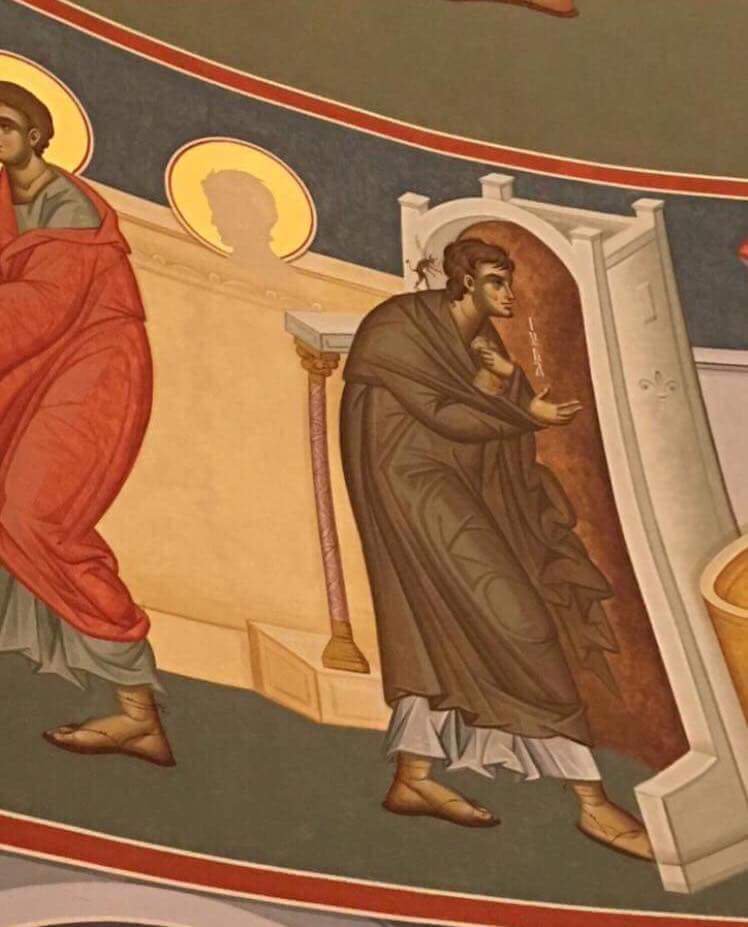
Saint Judas

Holy Wednesday – John 13:21-32
The Lutheran Diaconal Association – Valparaiso, IN

Saint Judas. Is that an odd phrase? Do we ever name churches after Judas? Or name our children after Judas? Though we do call people “Judas”, when they betray us. The name “Judas” has a strong association, and I think our gospel writer would be pleased. John’s portrayal of Judas is the harshest of any gospel. Jesus introduces him when he tells his disciples, “Did I not choose you, the twelve? Yet one of you is a devil.” (6:71) Awkward! We barely know Judas’ name, and already we know that he’s a devil. And John adds, “The one who would betray.” Judas is stamped from the beginning.

The next time we meet him is when Mary anoints Jesus’ feet with costly perfume. (12:1-8) John has Judas pitch a fit. The perfume could have been sold and money given to the poor. Again, John emphasizes, “the one who was about to betray Jesus”. But then John unloads. He didn’t care about the poor. He was a thief. He was an embezzler. I think that pales in comparison to betrayal, but clearly John wants us to know that Judas is a bad man. Except, it’s strange to bring up all this background dirt. Because when we get to the last supper, John says that the devil had already put it into Judas’ heart to betray Jesus. So what’s really going on here? Is it some silver coins that move Judas, or is Satan just pulling his strings? It’s ambiguous. After all, Jesus could exorcise a legion of demons, but not help his possessed friend? It invites re-interpretation.

Continue reading

Waiting for Some Good News

Reflection for Advent 2 – Isaiah 61:1-4, 8-11

Are you waiting for some good news?

In this Advent season, we’ve been reading the words of the prophet Isaiah. In our first week, we heard Isaiah cry out to God to “tear open the heavens and come down,” and we reflected on those times when we reach the end of our rope, and cry out to God, “why won’t you do something?” Last week, we heard Isaiah tell of a voice crying out “prepare the way of the Lord,” and we reflected on what that means and who’s called to do it. This week, we hear Isaiah telling us about God calling him to “bring good news to the oppressed.” So, we might ask ourselves, “are we waiting for good news?”

A lot of folks I know are waiting for good news. Some friends have lost jobs that were cut because of Covid restrictions or companies going out of business, and they’re looking for new opportunities. I hear folks in the neighborhood asking for referrals to get food and bill assistance because they’ve never needed help before. Other friends have been sick with Covid and want to know when their symptoms are going to subside. Some folks are anxiously waiting to hear that their loved ones can finally be moved out of intensive care, and aren’t allowed to visit. Though our situations may be different, in one way or another, I think we’re all waiting for some kind of good news. What kind of good news are you waiting for?

Continue reading

Largely Silent but Still Here

For as much as I love writing, you might think I’d be doing more of it while in seminary. I have plenty of moments of losing myself in thought, to be sure. But, somehow there’s always something of a logjam between me and the writing. I don’t mean papers or assignments – I mean this blog, where I theoretically work out *stuff*. Ah well. It does more good to just be thankful for a moment that drives me back here. And, I just had a couple thoughts…..

Continue reading

I Am a Disciple of Jesus Christ

I Am a Disciple of Jesus Christ

I just got back from Emergence Christianity, a conference that was just held in Memphis. More about that later. But the main thing I want to say here is that I am a disciple of Jesus Christ. It feels really odd for me to say that, maybe because I’ve spent time as the outsider rejected by the church. Or maybe it’s because I’ve heard churches harp on it, so obviously we’re failing, right? Or maybe it’s something about that old Adam vs. new Adam thing, that actually leaves us feeling like we could never be disciples of Jesus.

Well, in the end, it feels strangely empowering to me to be able to make this statement to myself. A declaration of who I am under God, and within the church – the body of Christ. I have much reflection to do on this. But in any case, I just want to declare this for myself, because I sense it’s important, and something is changing in my thinking that I don’t yet perceive.

What Is Mission?

It has taken me since May to finally realize just this single thought. Mission is realizing that we are the in-breaking of the kingdom of God, and not just observers being convinced that it’s happening and feeling joy because of it.

I understand “post-Christian” in these times to mean that Christianity is not the only game in town. It doesn’t make good citizens, necessarily. I work with atheists, Hindus, and I’m sure plenty of other faiths each day. Yes, atheism is a faith. The old assumptions no longer apply, that everyone automatically knows what I’m talking about. When I realize I just asked my Hindu colleagues what they’re doing for Christmas – that’s me forgetting that we’re post-Christian, and falling into old, dead patterns.

In Sunday worship, we’re reminded that we are witnessing the in-breaking of the kingdom of God. It defies conventional wisdom, and stretches into a justice, equality, and peace that we otherwise cannot perceive. When we allow our imaginations to blossom, we can believe that we see it, and it becomes our reality. The kingdom of God has become real in our hearts.

But then, the big leap is to connect ourselves to that very in-breaking. To self-identify as being a part of it. Missional thinking is that self-identification, and letting it inform our actions.

It’s me reflecting on what I see and hear in my own congregation, and naming where I see us embodying self-centeredness. I may be right or wrong, but the resulting tension I feel and that drives me to question is me acting in a missional way. It’s that impelling pressure perceived by others that embodies me living out my missional calling within the body of Christ. And allowing my faith to imagine that it takes seed where it might (thinking the Parable of the Sower). As more of us become missional, we collectively push on the institution of the Church as it is, keeping in mind that we sometimes misinterpret or apply our own biases inappropriately, but still pushing nonetheless.

Much as we depend on retelling each other the Gospel, we depend on each other being missional.

To be concrete – it’s me reflecting on where I see self-centeredness. It’s me serving my congregation to offer intercessions or Sunday School classes that engage the idea of how we are the in-breaking of the kingdom of God. It’s not something “over there” just to give us hope. Beyond that, it’s us here and now. We are the in-breaking of the kingdom, and the acting required for that is our action.

Reflection on Luke 3:7 – Third Sunday of Advent

As the people were filled with expectation, and all were questioning in their hearts concerning John, whether he might be the Messiah, John answered all of them by saying, I baptize you with water; but one who is more powerful than I is coming; I am not worthy to untie the thong of his sandals. He will baptize you with the Holy Spirit and fire. His winnowing fork is in his hand, to clear his threshing floor and to gather the wheat into his granary; but the chaff he will burn with unquenchable fire. So, with many other exhortations, he proclaimed the good news to the people. – Luke 3:15-18

Wow, so what the heck kind of Advent reading is this? With a friend like you, who needs a…. fill in the blank.

Continue reading